How to Snack Better...

When performing a nutritional consultation, I often get questions about snacking between meals. I don’t believe that eating every two to three hours is a necessity for all healthy eaters, but when snacks are necessary it’s important to adhere to a few basic rules:

  1. Include protein with your snack- Protein is broken down in the body and his a minimal effect on blood glucose levels if adequate insulin is available. In one study, men eating a high-protein, high-fiber snack bar had lower levels of the hunger hormone gherlin and higher levels of the fullness hormone GLP-1. They also took in an average of 425 fewer calories per day (1). When you are hungry, avoid snacks that are only carbohydrates as this will cause your blood sugar to spike and crash, causing you to be hungry soon after snacking. Protein, fat, and carb in snacks as well as meals.

  2. Vegetables are your friend- If you are looking to lose body fat, vegetables tend to be lower in calories, yet pack a way more powerful punch when it comes to keeping you healthy and full for longer. This all means you may tend to eat fewer calories, while still feeling satisfied, if not more satisfied, than when you rely on packaged foods and foods devoid of nutrients.

    1. Here’s a quick, easy, and tasty vegetable snack recipe:

      Cauliflower Popcorn:

      Bake in the oven for 30 minutes, and then sprinkle with onion powder and chives.

cauli.jpg

3. Plan Your Snacks Ahead Of Time-Though this one seems obvious, when we are hungry we have to have options readily available or else we will dash for the vending machine or convenience store. Keeping fresh fruit, pouches of nut butter, or your favorite healthy snack bar in your desk at work or in the glove compartment can save you in a pinch!

Wondering if your snack options are setting your diet and nutrition back? I’m here to help! Click the link below to book a free assessment today!

How To Eat More Vegetables...

DSC07394.jpg

When trying to lean out vegetables are your friend. They are high in fiber, vitamins, minerals, and can help fill you up when you are hungry. The push back I get from most clients is that they hate eating vegetables. Like really hate them. My usual response, “Which vegetables have you tried?” and “How do you cook them?” Honestly, a majority of the nutrition clients I work with have already made up their minds that they hate vegetables before they have even given them a real chance.

When giving my 6 month old vegetables for the first time, I didn’t give him a bunch of raw broccoli and say, “Have at it kid!” That would have been a disaster. My fiancé started by mixing the veggies with different sweeter fruits and formula so the veggies weren’t so overpowering. As he got more used to eating veggies, we slowly increased the amount of vegetables the meal consisted of. In the picture above, Elliot is scarfing down a mashup of peas, corn, carrots, pumpkin, and formula. You don’t have to do the same thing, but with a little effort, you can find a few ways of preparing vegetables so that you can learn to love them and reap the benefits they possess.

Here are 3 ways to make vegetables taste great:

  1. Roasting-Roasting brings out the natural sweetness in vegetables. I have found this is the easiest way to get your kids (and your husband) to eat them. Cut everything into uniform pieces, toss in your cooking fat of choice, and roast at 400° until veggies are soft and slightly browned. Our favorites are Brussels sprouts, sweet potatoes, carrots, and zucchini. Why is this a hack?

  2. Season Your Veggies-Let’s face it, plain veggies are meh. Stock up on a few awesome spice blends, or make your own. Toss your veggies in spices before roasting, or sprinkle some on just before serving. A little garlic salt or nutmeg go a long way!

  3. Cheese It Up-Sprinkle some parmesans on your veggies. As long as you don’t drown your broccoli, the sprinkle will help A LOT in the flavor department.

Need more help getting vegetables into your diet? I’m here to help! Click the link below to book a free assessment today!
How to Workout in 30min?

Welcome back to another workout of the week!

This week, I put the baby down for a nap and knew I had just about 30 minutes to get a workout in. I decided to grab a kettlebell, my assault bike, and the DIY farmer's handles and complete a continuous 30 minute circuit:

10cals Assault Bike

2/arm Turkish Get-Up

50m Farmer's carry.

Tips for this workout:

1. This is a 30 minute workout so the pace should be continuous. If you were to time how long the rounds take, the first round should match the last round.

2. Take your time on the Turkish get-up and use perfect form. On these I would really focus on trying to reach up through the shoulder while keeping the ribcage down.

3. Go heavy on the farmer's carry. These DIY handles cost about $60 to make (compared to two handles plus weights would cost $150-$300). By the end of the 50 meters, you should be pretty gassed.

I post this workout to show you what my workouts look like on a regular basis. Nothing too fancy and 100% of the time they are under an hour. Goes to show to look and feel great, you don't have to spend hours in the gym. You just have to train smart, have an intention on working on what's important, and then be consistent. I hope this helps!

Looking for a personalized touch to your workout routine? Floch Fitness offers individualized training programs that are tailored to your skill level, equipment availability, and goals. Click the link in my below to sign-up for a free assessment.

Should You Be Squatting?

Untitled design (4).png

In the fitness world, squatting is dogmatic (in this article when I mention squat I mean a two-legged deep squat). There are even some coaches that say everything can fix everything and can increase performance for everyone. In my experience with aging athletes however, the need to squat varies widely. Many of my clients will never deep squat to reach their goals, while others will go through a systematic progression that will take years in order for them to get to a deep squat.

The biggest reason I resist throwing clients directly into squatting (especially deep squatting) is there are requisite are ribcage, back, hip, knee, and ankle ranges of motion the client will need to perform a safe squat. For instance, if you have concentric orientation of upper ribcage (caused by a lack of dorsal rostral expansion), it will impede an upright squat and force the client into a compromised squatting position (leaned over). This leads to an overuse of the lower back muscle and minimizes the value of the squat in increasing muscle in the glutes, hamstrings, and quads. There are TONS of other exercises that I will utilize to build these areas that have a lot more effectiveness and less of a learning curve. These movements include single leg squats, split squats, lunges, hip thrusts and step-ups just to name a few. If I feel the need to progress a client in bilateral squatting, I will most of the time utilize kettlebells in the front rack position as this allows for: 1. A more upright squat 2. Safer loading (in case the client needs to get rid of the load quickly) 3. Aids in mobility of the ribcage through breathing. If you are having back, hip, or knee issues, it may be time to 86 the squat and work on your mobility, ability to inhale/exhale, and technique. Need help? I am here to serve. Click the link below to book a free assessment today!

To learn even more about squatting assessment and progressions, you won’t want to miss Scott Hagnas and I’s most recent podcast. Click below to listen!

6 Amazing Shoulder Press Variations...

aging athlete (9).png

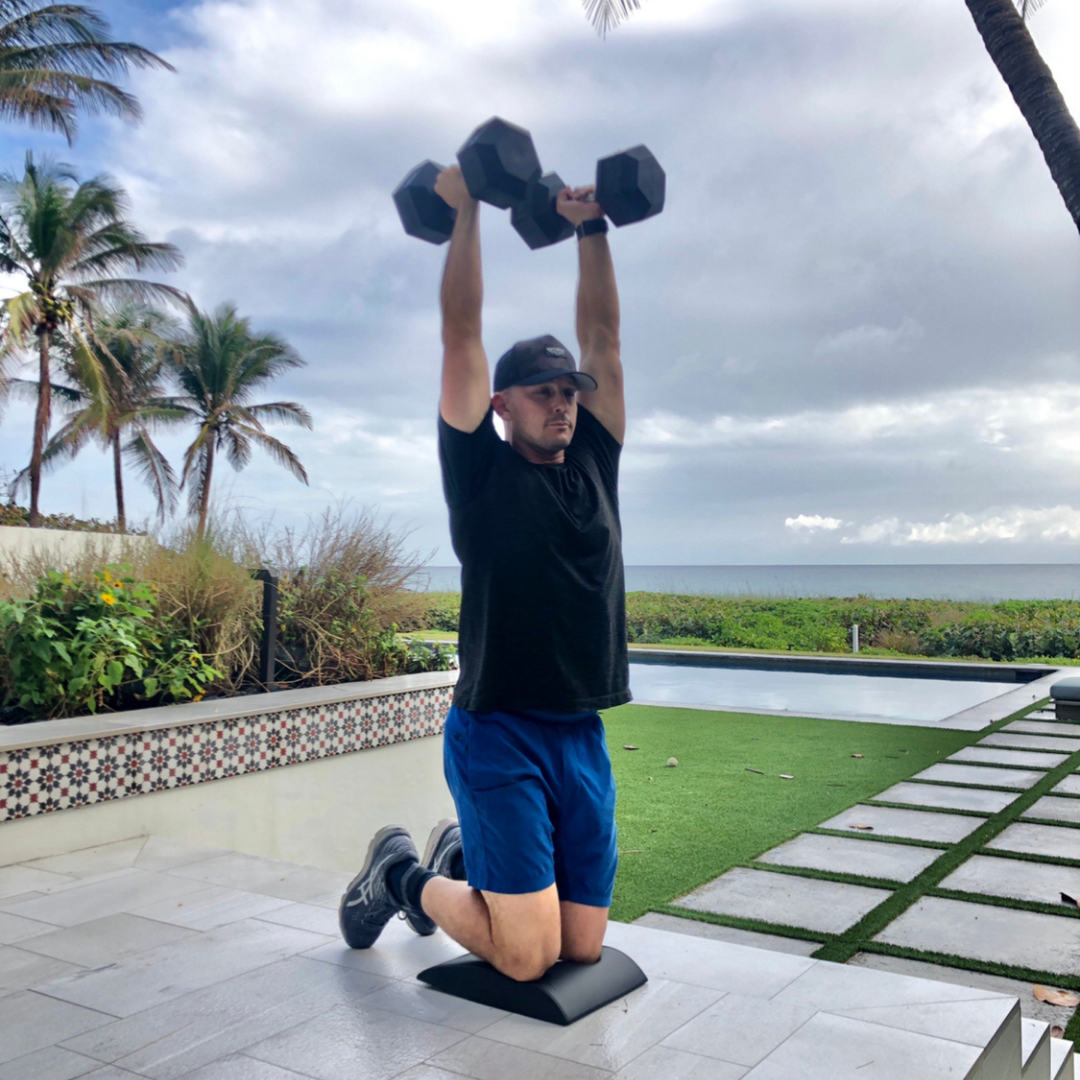
Looking for some variety in your vertical pressing that keeps the strain off the joints? These dumbbell pressing variation are a great option. Why dumbbell pressing? Using dumbbells allows the joint to move more freely than when your hands are fixed to the bar. On top of that, doing one arm at a time allows you to work on asymmetries and different breathing and compression strategies that you wouldn’t otherwise be able to practice with the barbell.

When incorporating these exercises into your training routine, start with a weigh that you can do 8-10 reps for 3 sets. From week to week, increase the number of reps with the same weight. Once you are able to do 3 sets of 15 reps, increase the weight by 5% and decrease the reps back to 8-10. Once this movement feels good and your range of motion has improved, work toward mastering the next movement.

Need additional help mastering overhead pressing? I’m here to help! Click the link below to book a free assessment today!

How Much Protein Should I Have?

protein.png

A common question I get from aging athletes who are working on improving their nutrition: “How much protein should I be taking in?” My response, as always, “It depends!” Epidemiological studies and clinical trials support the need for higher protein intake by older adults. Several epidemiological studies have found a positive correlation between higher dietary protein intake and higher bone mass density39, 40, 41; slower rate of bone loss42; and muscle mass and strength.43 One epidemiological study showed a positive association between higher dietary protein intake and fewer health problems in older women.

My first consideration however is the client’s goal. Do you want to increase lean muscle mass, improve and fuel performance, or are you to just be healthy and fit for a long time? You may have heard as a general rule, you should eat 1 gram of protein per pound of bodyweight. For instance, if you are a 185lb. person, you would eat 185g of protein daily. But this does not account for the client’s goals, ability to digest protein (multiple factors here), and their gender. I like to use a range instead 0.8g-2.0g protein per pound of bodyweight. This account for activity level, training goals, gender, lean muscle mass, and any other factors that are established during the clients assessment.

A 150lb. female looking to lean out and maintain bodyweight weight would be consuming ~135g protein daily, whereas a 200lb. man looking to put on 10lbs. of lean muscle might be consuming 200-300g of protein daily.

Wondering how much protein you should be taking in? Book a free nutrition assessment today!

Reference

The Best Butt Workout...

When I ask people what type of workouts they want to see more of, they always respond, “BUTT!” Well here is a 15 minute workout that will light up your backside! No equipment needed. The difference between this workout and every other one of the internet is the emphasis of position the glutes in a way where you can actually use the glutes during exercise. Grab you yoga mat and an exercise band and have some fun! Please let me know in the comments of what you thought and what you’d like to see next!

Strengthen Your Hamstrings!

The hamstrings play a big part in not only the health of the knee, but the stability of the pelvis. Single leg work allows me to position the muscles properly in order for the client to build the hamstrings. Hinging (bending over at the waist) is accesses the hamstrings strikes fear into the hearts (or backs) of most aging athletes. For better hinging, work on getting a solid ribcage position and a back pocket tuck. From there, isolate one side and go nice and slow on the way down.

These single leg variations are an awesome addition to anyone’s workout routine, and allow for tons of variety. Try each exercise for four weeks, build the intensity (increase weight, reps, or sets) then switch to a new exercise. Your hinging will improve guaranteed!

Looking for a personalized touch to your training? Click the link in my bio to set up a free assessment today!