Great Exercises With Your Adjustable Bench

exercises for your adjustable bench (1).png

Many of us out there have purchased an adjustable bench and use it only for bench press or worse, collecting dust in your garage. Adjustable benches have a multitude of uses, which is why I recommend when building out your home gym to get one of these instead of a flat bench that’s not adjustable. You can use them for incline presses and pulls, ab work, decline pressing, and so much more.

Here is a video of my favorite total body workout using the adjustable bench.


Looking for more exercise and workout ideas with a personalized touch? I’m here to help! Click the link below for a free assessment.

What Equipment do you need?

IMG_9079.JPG

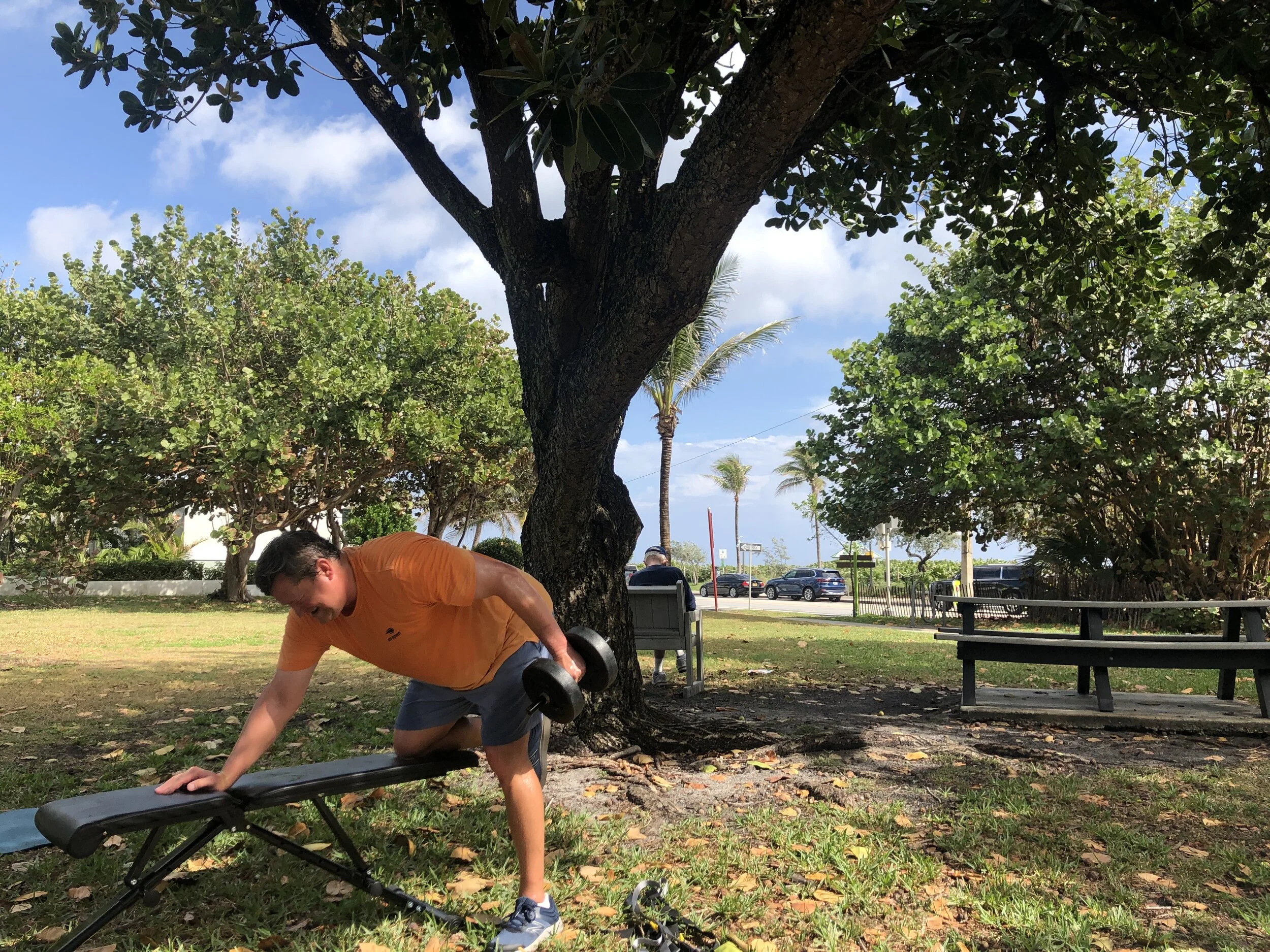
Here is a friendly reminder that you do not have to belong to a gym to have a great workout. Exercising in your garage, backyard, or a park is always an option!

Since stepping away from owning and operating a gym, I have spent most of my time working with clients outdoors with minimal equipment. I am often asked what the essential pieces of equipment are in order to be able to train the entire body. Here is a list of a few inexpensive equipment purchases you can make to supercharge your workouts:

  1. TRX (~$100)-I have spoke about TRX in the past, but I can’t emphasize enough how many great exercises you can do with the TRX. You can even hang them from a tree!

  2. Adjustable Dumbbells (~$120)-You’d be surprised at how many exercises you can get done with a simple pair of dumbbells, especially unilateral movements. In addition you can do almost all the barbell movements you love with dumbbells (and the are often much more challenging)!

  3. Kettlebell (~$30-$100)-For this piece of equipment I would keep it in the moderate to heavy range. This will give you the ability to go heavier on bilateral squats, deadlifts, and use it for conditioning movements like swings, cleans, and snatches. As a bonus, you can use it as resistance for drags and pulls in the sand (video to come)

  4. Step/Bench Combo (~$130)- Not only can you use this piece of equipment for cardio, but there are a ton of different squat, row, and hip thrusts exercises that I use with this step combo.

Once you have your equipment, the next step is creating an exercise routine that works for you and your goals! If you need help constructing a program that you can stick to, I’m here to help! Click the link below to book a free assessment.


Prepping for golf and tennis season...

DSC07514.jpg

Tennis (pickle ball/racquet ball) and golf are some of the most popular rotational sports for aging athletes. Rotational sport refers to the idea that the main movement component is rotating in the transverse plane around the body. Unfortunately, most aging athletes don’t have the requisite movement capacity to play their respective sport without some layer of compensation or pain. It’s no surprise that both of these sports have elbow injuries named after them (tennis elbow and golfer’s elbow).

During winter months, aging athletes should be using this time to prep for the upcoming season, working on strengthening the hips, shoulders, and core. Unfortunately, athletes don’t have the wherewithal to do so and end up jumping head first into the spring season, setting themselves up for poor performance at best and injury at worst.

There are three main areas that I focus on when working with athletes that require the rotational components of these sports:

  1. Shoulder/Trunk Rotation- In order to swing a club or racquet efficiently, you must be able to rotate and load the shoulders, then rotate and unload the shoulders. Most athletes that I work with have a super flat upper thoracic spine (between shoulder blades) preventing them from rotating the shoulders properly. This leads to downstream affects in the wrist and elbow. To address these insufficiencies, breathing exercises inspired by the Postural Restoration, Zac Cupples, and Bill Hartman are my go to. A basic exercise like rock back breathing can help immensely when it comes to improving shoulder and trunk rotation. It’s just a start but it will surely get you going in the right direction.

  2. Core-Obliques and transverse abdominis must be trained frequently for rotational athletes in order to connect the lower and upper body. Without a strong and coordinated core, athletes are left relying on the extension of the lumbar muscles in order to stabilize the rotation of the spine. When athletes this core, they think crunches and sit-ups which further exacerbates the problem of too much flexion from the spine. Due to the sheering nature of an overextended spine, the vertebrae are left vulnerable to injury. My go to exercises for training the core are planks and crawling variations. If you are able to hit these movements with good capacity, not only will you create safer movement, you will also increase performance.

  3. Hips-Rotation of the hips is extremely important for proper form in tennis players and golfers. Specifically internal rotation of the hip. Most athletes who rely on sagittal plane exercises (moving forwards and backwards) will have a hard time rotating the hips due to the extension compensation that most utilize with bilateral squatting and hinging movements. My advice to improve hip rotation is to focus on deadlifting, lunging, and squatting (and even rowing and pressing) from a single leg, split stance, or rear foot elevated position. This will allow you to train one leg at a time and drive better hip rotation.

There is so much to unpack to create progress, and the needs are usually individualized. Scott Hagnas and I go into great lengths on how we train aging athletes in the off season for tennis and golf. Click the link below to listen!

If you are looking to add velocity to you serve, yards to your drive, or just to play pain free, I’d love to help! Click the link below to set up a free assessment today. We’ll have you playing better in no time!

I Can't Believe I’ve Been Making This Sleep Mistake...

ig.jpg

My goals right now are to have better energy, maintain body composition, and improve productivity. Prioritizing quality sleep is an integral peace of the puzzle to improve these areas. Recently however, I have been really fatigued and waking up at 1am, unable to get back to sleep. In an attempt to remedy this sleep disturbance, I have tried tweaking my diet, making sure I wasn’t drinking too many fluids close to bed time, and meditation with no resolution of the insomnia. When I run into a problem like this, I take to researching experts in the respective field.

I came across a great article from Nick Wignall, and brought to my attention that I may be going to bed too early! According to Nick, “Tired is a broad umbrella term for fatigue or exhaustion. Sleepy is the very specific term for when your body is ready to fall asleep. When people cross the finish line of a marathon they’re often quite tired, but I’ve never heard of anyone falling asleep at the finish line. Similarly, after a long day at work with multiple physical, mental, and emotional stressors, you may feel extremely tired, but that fact is often independent of sleepiness. The foolproof way to know when you’re truly sleepy and not just tired is droopy eyelids. During the evenings, try to notice the difference between tiredness and sleepiness, so that you can more effectively refrain from getting into bed too early.”

When I read Nick’s article, it hit me that a few weeks ago I had pushed my bedtime to an hour earlier because our newborn Elliot had been waking up at 5:30am (as opposed to his normal time of 7am). So in trying to regain some hours of sleep, I moved my bedtime earlier. There was an issue with this as Nick explains, “We make the old mistake of believing that quantity rather than quality of sleep is what’s most important. Remember: 6 hours of quality sleep beats 8 hours of crummy sleep every time. If you’re worried about performing well tomorrow, remind yourself that the quality of your sleep is the most important thing to prioritize. If anything, you should try to go to bed slightly later than usual before a big day since this will allow your sleep drive to build up even further, increasing the odds of falling asleep quickly and staying asleep.”

Having a set bedtime is a good thing, however you need to be sleepy at bedtime, not just tired. Nick writes, “Tired is a broad umbrella term for fatigue or exhaustion. Sleepy is the very specific term for when your body is ready to fall asleep. When people cross the finish line of a marathon they’re often quite tired, but I’ve never heard of anyone falling asleep at the finish line. Similarly, after a long day at work with multiple physical, mental, and emotional stressors, you may feel extremely tired, but that fact is often independent of sleepiness. The foolproof way to know when you’re truly sleepy and not just tired is droopy eyelids. During the evenings, try to notice the difference between tiredness and sleepiness, so that you can more effectively refrain from getting into bed too early.

TAKEAWAY: Only get into bet when you are truly sleepy, not just tired.”

With these concepts in mind, I started waiting until I felt sleepy before getting into bed at night (that being said, you have to give yourself an opportunity to get sleepy by winding down, which I’ll discuss in depth in a future article). Not only was I able to fall asleep faster, I had better quality sleep despite not being in bed as long. I will see where the next few weeks take me (and their are some other hurdles around sleep that I have to address) but the results look promising. I’ll keep you posted!

Self assessing is challenging as you can’t read the label from inside the bottle. It takes experience and knowhow to create change. If there are areas of your own health and wellness that need work, I’m here to help! Book a free assessment today and let’s get you going toward the best version of you!

What to do with a TRX?

Untitled design (6).png

During the pandemic, at home training equipment has been hard to come by, but a purchase many individuals have made is a TRX Trainer. The TRX plays off of gymnastics rings in that they are versatile, compact, and portable, but they leave the rings behind in adaptability. You see, to rig up a TRX, you need nothing but a door, which makes them ideal for training indoors, in the backyard, or in a hotel room. Additionally, you can use the TRX to hit almost every body part (list here). Here is a video of some of my favorite upper back mobility and strength exercise that I use with my clients on a regular basis.

A tool is only as good its user. To best utilize your TRX trainer, you need a goal for the training session. It could be total body (legs, arms, and abs) or a specific body part. Once you have a goal, it’s time to choose 4-5 exercises that fit into your goal. For instance, if I want to train total body, I might use the trainer for:

  • Split Squat (knee flexion)

  • Glute Bridge + Hamstring Curls (hip extension)

  • Push-Ups (horizontal pushing)

  • Body Row (horizontal pulling)

  • Plank Holds (core)

Once I have chosen my movements, I would cycle through each movement for 12-15 reps at a 3 second negative tempo and fast on the way back up (core movements would be held for 30-60sec). As for rest, pause between separate movements long enough for you to catch your breath and let your heart rate recovery. You want to keep the sweat going, but you don’t want to go so fast that the quality of you reps drops off. Repeat this cycle for 3 sets. In 20 minutes, your work is done and you are on with your day!

Need some extra help constructing your workouts to fit your specific needs? Floch Fitness offers at home personal training and custom training programs to get you moving toward the best version of you! Click the link to book a free assessment today!

How Intense Should My Training?

As aging athletes, it’s hard to determine what type of intensity is optimal for your workouts. After all, harder is better right? Not so fast! In my experience working with thousands of individuals in my career, the clients that were most successful in reaching their goals didn’t go 100% all the time. In fact they rarely went 100% (that’s in weight training and cardio). Why? As aging athletes, stress tends to run our world (work, kids, etc.). Adding more stress to an already stressed system only causes progress to slow. To create change in your body, you need to add enough stress to the system for the body to respond and grow stronger, and then stop. In fact, their is research to back up the claim that if you want to improve strength and size, you actually require less stress, than more stress (1).

On rare occasions, I’ll work with clients and we will “open up the taps” at the end of workouts (see video below of Prof G crushing a Ski Erg Sprint). These efforts are done to assess where an individuals progress is, feelings of euphoria/achievement, and adjusting what our efforts feel like. However, the all out efforts are always done in a safe manner for the body (loads are lower and competency of the movements are high). I will never take my clients to uncharted waters without them knowing, with confidence, what they are doing.

If you are smashing your head against the wall in your workouts, but aren’t seeing progress, the answer probably isn’t harder. The answer is most likely less but smarter. Need help charting a course to the best version of you? I’m here to help! Sign-up for a free assessment today!

Strength and Conditioning In One Workout

Finding time for both strength work and conditioning can be really challenging sometimes. In a survey conducted by OnePoll on behalf of fitness app creator Freeletics, it turns out “not having time” took home the first-place crown with 42 percent saying that time is the biggest reason they fail to work out. If you fall into this category, kettlebell complexes should be your friend! I really like kettlebell complexes for a few reasons:

  1. Because of the ergonomic design, you don’t need to warm-up nearly as much as with a barbell

  2. You can do hundreds of different exercises

  3. You can combine strength work and conditioning at the same time

I was pressed for time the other day, so I threw together this complex:

  • 10 Single Leg RDL

  • 10 Single Arm Press

  • 10 Front Rack Reverse Lunges

  • 10 Bent Over Rows

I performed all four exercises in a row on one side, then did all four on the opposite side. I rested 2 minutes, then I repeated for 3 sets. In total, with a brief warm-up, this workout took be 20 minutes. In other words, if you have 20 minutes and a kettlebell, you can get a fantastic total body conditioning workout in!

Looking for some more awesome custom tailored workouts? Book a free assessment today and let’s start working toward the best version of you!

Sets, Reps, Rest, and Tempo...

Untitled design (5).png

One of the fundamentals of both strength training and conditioning work is knowing how to manipulate the sets, reps, rest, and tempo of various exercises in order to get a desired affect. For instance, if told you to do 5 sets of 10 squats at your own pace versus 10 sets of 10 squats done at a 4 second negative and 3 second pause at the bottom resting only 20 seconds between sets, you are going to have a much different workout.

To master these variables, it takes years of educating yourself with data, research, and proven techniques blended with self discovery. One of the most challenging workouts I have ever performed is 10 sets of 10 reps with a 4 second eccentric (with gravity) and 2 second positive (against gravity) along with 60-120seconds rest between sets. This type of work was popularized by Charles Poliquin and he termed it “German Volume Training.” These workouts are designed to produce tons of lactic acid and muscle breakdown which could lead (under the right conditions) to fat loss and muscle gain. If you are looking to give this a try, pick a movement that you are comfortable with and possess good technique (you can use machines in the gym as well like a lat pulldown or leg extension machine). Let’s use the bench press. Perform 10 repetitions with a weight that you can do 20 times for a maximum (so if you 20 rep max is 100lbs., use that). Each rep should take 4 seconds to get down to your chest before you start pushing back up and take 2 seconds to lock out. There should not be any pauses at the top or bottom. After 10 reps, rest exactly 2 minutes, and go again, repeating until you get to 10 sets (100 reps). If you start to fail in the sets, that’s fine. Stop, rest 2 minutes, then start the next set. Do not force reps. Do not repeat sets. Over time (from week to week) you will be able to complete the entire workout. When you do, increase the weight by 5% and then try to complete it again. You can do this for weeks on end and see some serious improvements in body composition as a result. I will warn you though, these works are really hard. Like, you may need a nap after the workout hard. You can also try this from home with bodyweight movements as well (e.g. push-up, body rows, and squats). Give it a shot for your next workout!

To learn more about sets, reps, tempo, and rest, list to Scott Hagnas and I’s most recent podcast!

Do you workouts need work? I’m here to help! Book a free assessment today!